Download Ebook Echoes of Scripture in the Letters of Paul, by Richard B. Hays
Download Ebook Echoes of Scripture in the Letters of Paul, by Richard B. Hays
Do not you assume that checking out publications will provide you more advantages? For all sessions and sorts of publications, this is taken into consideration as one way that will certainly lead you to get finest. Each book will certainly have various statement and different diction. Is that so? What concerning guide qualified Echoes Of Scripture In The Letters Of Paul, By Richard B. Hays Have you heard about this publication? Begin; don't be so careless to understand more about a book.
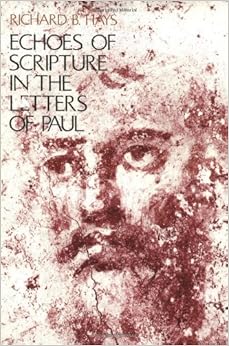
Echoes of Scripture in the Letters of Paul, by Richard B. Hays

Download Ebook Echoes of Scripture in the Letters of Paul, by Richard B. Hays
Searching specific book in the books keep may not assure you to get guide. Have you ever encountered that issue? This is a very common trouble that many people face while going to get or buy such certain book. As usual, a number of them will run out of guide detailed as well as supplies in guide stress additionally, when it associates with the new launched book, the most effective vendor publications, or the most prominent books, it will allow you wait for more times to get it, unless you have deal with it promptly.
Every word to utter from the writer involves the component of this life. The writer really shows how the basic words can make the most of how the impact of this publication is uttered directly for the readers. Even you have found out about the content of Echoes Of Scripture In The Letters Of Paul, By Richard B. Hays a lot, you can conveniently do it for your far better connection. In supplying the presence of guide idea, you could discover the boo website right here.
No, we will share you some motivations regarding just how this Echoes Of Scripture In The Letters Of Paul, By Richard B. Hays is referred. As one of the reading book, it's clear that this publication will certainly be absolutely done significantly. The related topic as you require currently becomes the man variable why you need to take this book. On top of that, getting this publication as one of analysis materials will boost you to obtain even more details. As known, even more information you will certainly obtain, a lot more upgraded you will be.
Exactly what regarding Echoes Of Scripture In The Letters Of Paul, By Richard B. Hays If that's relevant to your problem, it will certainly not only give those ideas. It will give examples, easy and also easy instances of what you have to perform in solving your problems. It will additionally appear the result as well as type of the book that reads. Many individuals are falling in love in this publication due to the fact that its power in order to help everybody get better.
Review
"Hays has without doubt posed the right question at the right time within the horizon of a particularly important problematic. . . . A new beginning for the question concerning the reception of the Old Testament in the New."―Hans Hübner, Theologische Literaturzeitung"This carefully argued study (which is fully indexed and thoroughly footnoted) will be of interest primarily to faculty and graduate students with interests in either biblical literature or literary methods of allusiveness. It ought to be acquired for such audiences."―Choice"Elegantly produced. . . . Hays reads Paul’s letters as literary texts shaped by complex intertextual relations with Scripture."—America"This book is sometimes insightful, sometimes puzzling, sometimes provocative, but never boring. Everyone can learn from it."―E. Earle Ellis, Theology Today"A fresh interpretation of Paul’s references to the Jewish Scriptures. . . . Written in a lively, semipopular style, this important study succeeds in showing that Paul’s scriptural quotations and allusions are often more ’polyphonic’ and rhetorically meaningful than traditional exegesis has allowed."―David M. Hay, Interpretation: A Journal of Bible and Theology"Rich and provocative. . . . By penetrating and insightful analysis of many texts and by encouraging so many critical hermeneutical issues, Hays makes a material contribution to . . . [his] subjects."—Karl P. Donfried, Theological Studies"A major contribution to hermeneutics. . . . An intriguing publication which combines an impeccable knowledge of academic NT criticism with wide-ranging literary interests."—Arthur Long, Faith and Freedom"A major work on hermeneutics. . . . Hays’s study will be a work to use and to reckon with for every Pauline scholar and for every student of Paul’s use of Old Testament traditions. It is sophisticated, in both a literary and theological sense, and written with considerable wit and confidence."―Carol L. Stockenhausen, Journal of Biblical Literature"This lively excellent book is a fine effort to link the two worlds of modern critical New Testament scholarship and literary criticism. The book is clear and accessible to the nonspecialist as well as the New Testament scholar. It is up-to-date in the two worlds it seeks to bring closer together and discriminating in its use of secondary literature from each."—John H. Schütz, Bowman and Gordon Gray Professor Emeritus, The University of North Carolina at Chapel Hill"Written in a direct, engaging, lively manner, this is a study of great interest to literary students, whether of methods of allusiveness or of biblical literature."―Eleanor Cook, professor of English, University of Toronto"In the letters of Paul, the serious reader is faced with the fascinating challenge of developing a sensitivity to the resonances of intertextuality, and it is here that Hays makes his weighty and exciting contribution, helping us to sense the remarkable ways in which Paul heard the voice of scripture far beyond the confines of formal citation."―J. Louis Martyn, Edward Robinson Professor Emeritus of Biblical Theology, Union Theological Seminary
Read more
Product details
Paperback: 254 pages
Publisher: Yale University Press; New edition edition (January 27, 1993)
Language: English
ISBN-10: 0300054297
ISBN-13: 978-0300054293
Product Dimensions:
6 x 0.8 x 9.2 inches
Shipping Weight: 8.5 ounces (View shipping rates and policies)
Average Customer Review:
4.4 out of 5 stars
18 customer reviews
Amazon Best Sellers Rank:
#367,141 in Books (See Top 100 in Books)
Near the end of the book, you will find these two sentences: "We are children of the Word, not prisoners." "Those who would be faithful to Paul's word must take the risks of interpretive freedom." Those two sentences capture the gist of this lucid, learned and, inspiring book. Mr. Hays is an accomplished writer and thinker that, I dare to say, has been guided by the Holy Spirit. He argues that Paul's main preoccupation when dealing with the proclamation of the Gospel was to establish, through the use of Scripture, that the Christian community was a Spirit led community that had had the Word inscribed in their hearts by God. Mr. Hays shows how Paul's bold interpretation of Scripture becomes a template and an example to follow for all Christian communities when looking for guidance in Scripture. Let us heed this important message by Mr. Hays and may the Spirit of God guide our interpretation of Scripture in order to live according to the Will of God.
Dr. Hayes is one of the most respected modern American New Testament scholars. He takes the readers through Paul's letters (at a summary level) tying them to the other books of the bible.
Is Scripture an unchanging word, fixed in the past, or is it dynamic, alive, taking on new meanings as it addresses competent readers in the present? Who is a competent reader? And, Richard Hays asks, "If the word is so alive and active on the lips and in the hearts of the community of faith, how then must we read?" These are questions that, directly or indirectly, occupy most of Echoes of Scripture in the Letters of Paul, where Hays examines some of Paul's highly innovative scriptural readings. He treats Paul's letters as "hermeneutical events," in which Paul reinterpreted Scripture for his churches. More than is usually recognized, Paul made use of intertextuality, embedding fragments of Scripture in his own discourse; in most cases he did so allusively, rather than by direct citation - the reader has to listen to the echoes of the original text in what Paul has written. Often enough, the echo is too faint to be noted. Of one instance Hays writes, "Any reader who knows where the words come from will surely smile in recognition of the point; most readers will miss the point altogether." The immense value of this study lies in its potential to lead earnest readers to a keener appreciation of Paul, as Hays uncovers suppressed allusions in a number of examples taken from Romans, First and Second Corinthians, Galatians, and Philippians.The effect is almost always surprising; sometimes one wonders at Paul's subtlety; at other times one asks whether it is really Hays' ingenuity that has conjured up an echo that did not occur to Paul. As it turns out, it does not matter. Hays argues that to limit the interpretation of scriptural echoes to what Paul intended is to create artificial limitations and restrict the hermeneutical freedom which Paul himself employed. For one thing, "what he intended is a matter of historical speculation;" for another, "Scripture generates through Paul new figurations." The implicit point is that a modern interpreter of Paul can learn from him how to read Scripture imaginatively, yet faithfully. This is treated at length in the fifth and last chapter of the book. Before then, in the first chapter, Hays reviews different approaches to Pauline hermeneutics and proposes his own, taking leads from literary-critical discussions of the "phenomenon of intertextuality." The following three chapters are a tour de force of riveting interpretation. If I have to single out one major theme among several - and which Hays works over and over from different angles - it would be that Paul understood Scripture (i.e., the OT) as prefiguring the church; it was neither annulled nor superseded, but pointed to the gospel as proclaimed by Paul. Hays speaks of the transforming power of Scripture rightly understood. "The meaning of Scripture is enacted in the Christian community, and only those who participate in the enactment can understand the text." He passionately pleads the same point in the page before last, a fitting conclusion to an insightful and original work: "Community in the likeness of Christ is cruciform; therefore right interpretation is cruciform. ... Any reading of Scripture that requires of us something other or less than this is a false reading."This remarkable book has not gone unquestioned by other scholars, and has generated lively debate among Paul's interpreters. Who should read it? There is more than a hint that Hays was writing for the academic community; but non-professionals familiar with biblical (or literary) studies can read it with profit and a sense of fulfillment. All readers must bring to it an energetic and open mind.
Richard Hays in his "echoes" and "Conversion of the Imagination" provides significant insights to Paul's use of the Old Testament. There are many perspectives on Paul these days but Hays understands the apostle rightly. What Hays does so well is not only point out the explicit OT references but the "echoes" and illusions to the Hebrew Scriptures that inform Paul's understanding of who the people of God truly are.This is a great work.
Good, helpful academic book.
This book is so good that I wouldn't take any commentary or treatment of Pauline literature that came after this book seriously if they did not deal with this book. Hays is not just an excellent NT scholar, but also a brilliant writer. All these factors make it a must-read​ for any serious student of Paul.
Hays points out that Scripture makes extensive use of literary techniques such as foreshadowing, metaphor, allusion, typology, etc. Thus it is best interpreted by a kind of literary sensibility, instead of solely through an analytical, factual approach.
Such a profound book. It is such a correction on so much simplistic understanding of the Apostle Paul.Such respect in working to understand but even more respect in working to explain. I just believe God will use this book to help His confused Church.This is for those who want to hear.Here is a quote he refers to in his book by T.S. Eliot "Where shall the word be found, where will the word Resound? Not here, there is not enough silence."Israel had a hard time hearing, now, today, much of the Christian world also has a hard time hearing with so much noise. Maybe some will want to hear. This book will help them.And I'm only half way through reading while writing this....
Echoes of Scripture in the Letters of Paul, by Richard B. Hays PDF
Echoes of Scripture in the Letters of Paul, by Richard B. Hays EPub
Echoes of Scripture in the Letters of Paul, by Richard B. Hays Doc
Echoes of Scripture in the Letters of Paul, by Richard B. Hays iBooks
Echoes of Scripture in the Letters of Paul, by Richard B. Hays rtf
Echoes of Scripture in the Letters of Paul, by Richard B. Hays Mobipocket
Echoes of Scripture in the Letters of Paul, by Richard B. Hays Kindle

0 komentar: